
Path of Survivor
| Genre | Shooting |
| Platform | Desktop browser |
| Developer | Mirra Games |
| Released | 2026 |
| Players | Single player |
| Price | Free to play |
| Rating | 4.7/5 from 90,911 ratings |
| Updated | July 2026 |
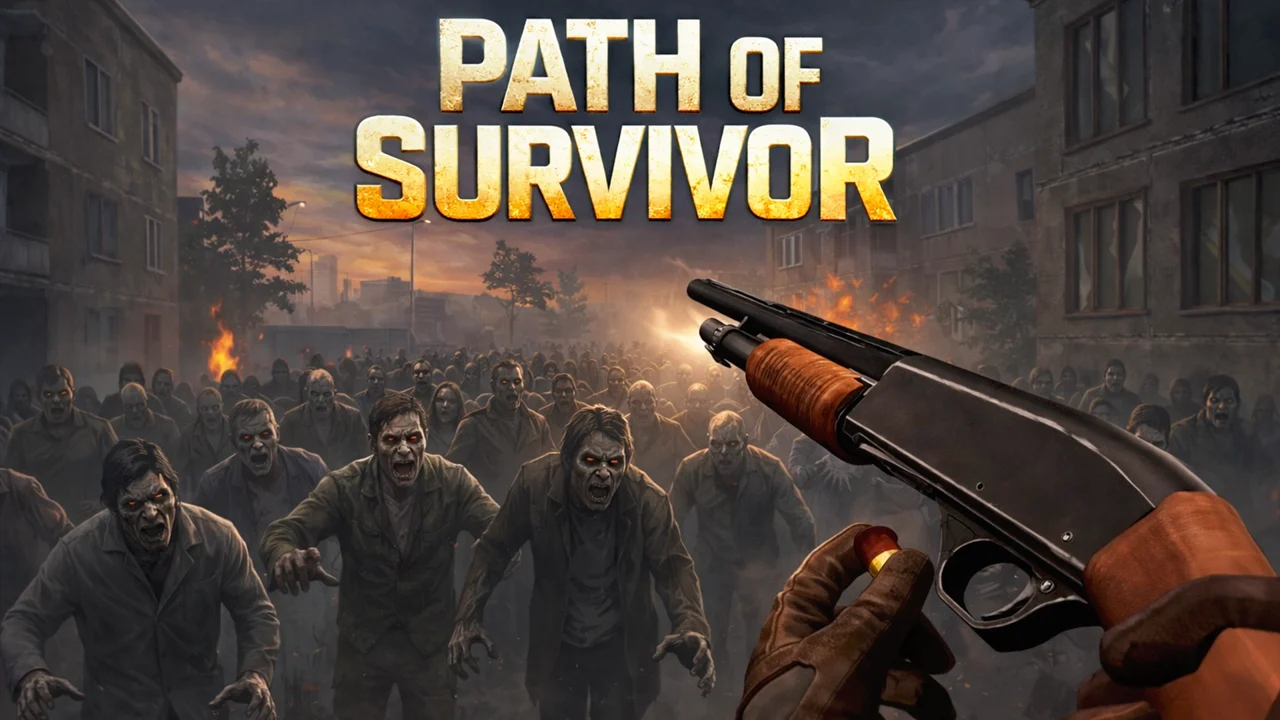
Path of Survivor drops you into the first hours of a zombie outbreak that began without warning. You play someone trying to get home to their family through a collapsed world, and the road between you and them is packed with the infected. It is a first-person survival shooter built on relentless enemy waves, scarce supplies, and a long string of locations full of strangers who may or may not be on your side.
The hook is the push and pull between aggression and caution. You start against slow-moving targets and a thin loadout, then earn a real arsenal through upgrades and grit. Bullets, medkits, and grenades do not grow on trees, so every corridor you clear is a small gamble about what comes next. It is free to play in your browser, no download, and it runs on desktop and mobile alike.
- A 3D first-person zombie survival shooter about fighting your way home through a world that fell apart overnight.
- Mow down waves of the infected, collect the gems they drop, and pick an upgrade each time you level up.
- Mission prompts guide you toward weapons, doors, and ambushes across new locations.
- Single-player journey with full keyboard and mouse play on desktop and twin-stick touch on mobile.
What is Path of Survivor?
Path of Survivor is a mission-driven first-person shooter with a horror tint. The setup is direct: the outbreak started fast, your family is somewhere out there, and the routes between you and them are crawling with the infected. You move from one location to the next, following on-screen prompts that tell you when to grab a weapon, open a door, or brace for an attack. Between fights you run into other survivors, and the game makes a point of reminding you that not everyone caught in the same disaster wants to help.
The core loop is move, fight, scavenge, upgrade. Infected drop experience gems when they fall. You collect those gems to fill your experience bar, and each level hands you a choice that shapes how you survive the next room. That progression is what pulls a run past the point where you would normally quit. You never quite feel finished, because there is always one more door to open and one more upgrade that would make the next fight survivable.
Aiming and shooting controls
The game uses standard FPS inputs on desktop and twin-stick touch on mobile. The full mapping is below, and it stays consistent across the whole campaign.
| Action | Desktop | Mobile |
|---|---|---|
| Move | WASD | Left virtual joystick |
| Look | Mouse | Right virtual joystick |
| Attack | Left-click | Auto-fire |
| Aim down sights | Right-click | On-screen button |
| Switch weapon | Mouse wheel or 1, 2 | On-screen button |
| Reload | R | On-screen button |
| Sprint | Shift | On-screen button |
| Interact | E | On-screen button |
| Use medkit | Q | On-screen button |
| Throw grenade | G | On-screen button |
| Flashlight | F | On-screen button |
| Inventory | Tab | On-screen button |
Keyboard and mouse play
On a keyboard and mouse you have a full hotbar under your fingers. Right-click to aim for tighter, harder shots, left-click to fire, and swap between weapons with the number keys or the scroll wheel. Reload early and often, because the horde does not pause while you chamber a round. Tab opens your inventory when you need to sort gear between rooms, and F flips the flashlight on in the dark stretches where infected like to wait. The sprint key is your panic button when a doorway turns out to hold more enemies than you budgeted for.
Mobile touch play
On a phone or tablet the left stick moves you and the right stick swings the camera. Firing is automatic, which keeps your thumbs free for the on-screen buttons that handle reloads, grenades, medkits, and interactions. The layout looks busy the first time you load in, but the buttons settle into muscle memory fast once your hands learn the spacing. Auto-fire is a real help here, since you only have to keep the infected inside your view rather than tap to shoot while also steering.
How to play
- Follow the opening prompt to grab your first weapon and get your bearings in the starting location.
- Push forward through the corridor, shooting infected that rush you and side-stepping their lunges.
- Walk over the experience gems every enemy drops to fill your experience bar.
- Pick an upgrade each time you level up, leaning toward the gap that just nearly killed you.
- Open doors and interact with objects when prompted to reach the next location and the next fight.
- Save your medkits, grenades, and ammo for the rooms that actually threaten you, and stay a step ahead of the horde.
Weapons and your upgrade path
You do not start with much. The early game hands you a basic firearm and slow-moving infected to practice on, and you have to earn everything better. Picking up new weapons as you explore is how you fill out your kit, because you never know which side passage hides exactly the tool you need. Upgrades are the other half of the equation, and they are tied directly to how many infected you put down. The table below lays out the pieces of the system.
| Part of the path | What it does |
|---|---|
| Weapon pickups | New guns found while exploring locations |
| Experience gems | Currency dropped by every infected you kill |
| Level-up choices | Offered each time your experience bar fills |
| Weapon upgrades | Improve damage, fire rate, or handling on guns you own |
| Medkits and grenades | Finite consumables to spend carefully between fights |
Leveling up with experience gems
Every infected you kill leaves behind experience gems. Walk over them to fill your experience bar, and when it tops out you level up and get a choice. These choices are the spine of a run. A smart pick early can carry you through three hard rooms, while a greedy one can leave you outgunned when the wave thickens. Read what each option actually does before you commit, and think about which weakness nearly ended you in the last fight. That is usually the right thing to fix.
Managing your stockpile
The journey is long, and the game tells you flat out not to spend everything at once. Medkits, grenades, and ammo are finite, and the rooms that actually threaten you tend to arrive without warning. Treat your stockpile like a budget. Use the cheap gun on the easy infected, save grenades for clustered groups blocking a doorway, and never pop a medkit at full health. Resources are the real difficulty, and a player who hoards well outlasts a player who shoots well but wastes every pickup.
The infected and the horde
Your enemies come at you in waves, and the pressure scales up the deeper you push. Early infected are slow and easy to drop, which lets you learn the aiming and reloading rhythm without much stress. That calm does not last. As you move into new locations the waves get thicker, the threats close distance faster, and you start meeting rooms where backing up is the only thing keeping you alive.
The horde is less a single enemy and more a tide you have to manage. You cannot stand still and out-shoot an entire wave if it catches you in the open, so positioning matters as much as accuracy. Doorways and hallways become tools, because a tight space forces the infected into a line where one gun can hold them. Dodging incoming attacks is part of the kit too, and a clean sidestep can save a medkit you would rather keep.
The journey and who to trust
The path home is not a single arena. You move through a string of locations, and prompts along the way point you toward weapons, doors, and the next fight. Exploration genuinely matters, because side routes sometimes hide the exact pickup you need to push forward. If a passage looks worth checking, it usually is.
You will also meet other survivors on the road. The game is clear that everyone is caught in the same mess you are, which means some will help and some will not. That friction adds a layer on top of the shooting. You never quite know whether the next person you bump into is a friend or a problem, and it is worth keeping your finger near the trigger during those encounters. The story gives the survival a point beyond score, since every step forward is a step closer to your family.
Tips to stay alive longer
- Aim down sights before firing on tough infected, since the tighter grouping saves ammo.
- Hoard grenades for groups clumped in a doorway or a tight hall.
- Grab every weapon pickup you find, because even a weaker gun has a use in the right room.
- Backpedal while reloading so the horde walks into your next magazine instead of your face.
- Spend level-up choices on the weakness that just nearly killed you, not on a strength you already have.
- Keep the flashlight on in dark areas so you spot infected before they are on top of you.
- Save medkits for after a fight, when you know how much health you actually lost.
- Check side passages for pickups before you open the next main door.
Is it free and safe to play?
Path of Survivor is free to play in your browser, with no download and no account. It runs inside the page sandbox here on African Safari Games, so there is nothing to install and nothing to sign up for before you start shooting. It works on most networks that allow browser games, and it loads on Chromebooks, Macs, and Windows PCs as well as phones and tablets. Because it plays in the browser, you can jump back into a run without keeping a separate app on your device, and your controls are the same whether you are on a laptop or a phone.
What makes Path of Survivor hard
The difficulty does not come from any one trick. It comes from scarcity. Ammo runs low, medkits run lower, and the infected never stop coming in waves that thicken the deeper you go. Stack on top of that survivors you cannot fully trust and locations that hide both rewards and ambushes, and the tension stays high even when the gunplay feels good. The upgrade choices are what give you a fighting chance, and getting those right is the part that pulls you back for one more room, then one more after that. It is a game that rewards patience and punishes waste, and that combination is why a single session has a way of stretching into a long night.
Why the progression keeps you playing
The reason Path of Survivor is hard to put down is that it never lets you feel finished. Each level-up is a small decision with a real payoff, and each new location promises a weapon or a fight you have not seen yet. You are always one room away from a better gun or one bad call away from a restart, and that swing keeps the loop honest. Add the story pull of getting home to your family, and you have a shooter where the next objective always feels close enough to reach. The deep progress tag is earned, not borrowed, because the upgrade path genuinely changes how later fights play out.
Play on mobile
Path of Survivor runs in your browser. If you want something similar to play on your phone, Fragen is a good pick.
Frequently asked questions
Is Path of Survivor free to play?
Yes. Path of Survivor is free to play in your browser with no download and no account.
How do I play Path of Survivor?
Follow the on-screen prompts, move with WASD or the left joystick, shoot the infected, collect their experience gems, and pick an upgrade each time you level up.
Is Path of Survivor multiplayer?
It is a single-player survival journey. You fight through the apocalypse on your own, though you meet other survivors along the way.
Who made Path of Survivor and when did it come out?
Path of Survivor was made by Mirra Games and released in 2026.
Can I play Path of Survivor unblocked at school?
Yes. African Safari Games hosts Path of Survivor unblocked, so it runs straight in your browser with no download on most networks that allow browser games.
Does Path of Survivor work on Chromebook and mobile?
Yes. It runs in any modern browser, so Chromebooks, Macs, Windows PCs, and phones or tablets all work, with full touch controls on mobile.
Path of Survivor gameplay video