
Bridge Race
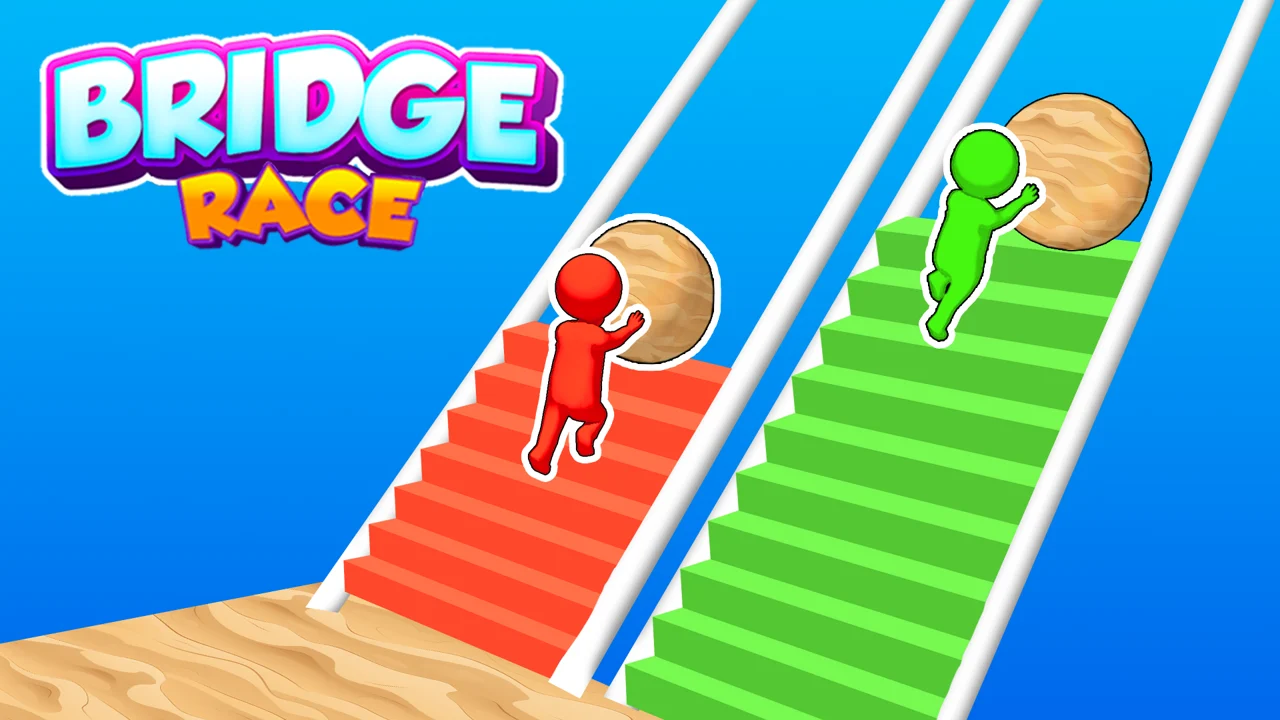
| Genre | Arcade |
| Platform | Browser, mobile and desktop |
| Released | 2024 |
| Players | Single player |
| Price | Free to play |
| Rating | 4.3/5 from 40,554 ratings |
| Updated | July 2026 |
Bridge Race drops you onto a colorful 3D board where the only job is to grab blocks, stack a path, and cross before everyone else. It is a casual collect-and-build arcade game with a competitive bite, because the rivals sharing your level are not shy about stealing your work. You play it free in the browser, with no download and no sign-up.
The loop is simple on purpose. Pick up blocks of your own color, ferry them to the bridge gaps, and lay them down until your path reaches the next platform. What turns a calm builder into a tense race is that three or four other stickmen are doing the same thing at the same time, and they will happily undo your progress the moment you turn your back to fetch more blocks.
- Arcade collect-and-build game where you ferry colored blocks to finish your bridge first
- Free to play in the browser, with a free Android app on Google Play if you want it on a phone
- Stickman characters on a bright 3D course, with several rival builders sharing every round
- Sabotage is built into the rules: rivals steal your blocks and pave over your path while you work
- Quick rounds that fit a five-minute break, then ramp in difficulty as you keep winning
What is Bridge Race?
Bridge Race is a competitive casual building game in which you gather blocks of your assigned color and use them to construct a bridge to the next island. The character you control is a stickman, and you steer them across a floating 3D course that is split into collection zones and gap sections. Each bridge gap is a grid of empty tiles, and only blocks in your color can fill them. Reach the end of the final bridge before the other stickmen and you win the round.
What separates it from a solo stacking toy is the cast of rivals. Every level has other stickmen working their own bridges in their own colors, and the game actively rewards bumping into them. You can knock a rival off their run, swipe blocks they have dropped, or pave over tiles they already claimed. None of it is polite, and that is exactly the point.
The result sits between a puzzle and a small battle. The building half is soothing, with soft pop sounds on every block you place, while the rival half keeps you glancing over your shoulder. Holding both at once is what a round actually feels like.
How to play
- Step onto the colored block pile that matches your stickman and pick up as many blocks as you can carry.
- Walk across the board to your bridge gap, and the blocks drop automatically to fill the empty tiles.
- Keep fetching and laying until your path reaches the next collection area or the finish line.
- Watch the rivals near you: bump them to slow them down, and guard your stack when you head back for more.
- Use obstacles like slides and elevators to move faster and reach platforms you cannot walk to.
- Cross the final bridge before anyone else to take the round, then queue the next, harder level.
Controls and movement
Movement is the whole game, so the controls are kept light. You only steer, and the building happens on its own when you walk across a gap. That leaves your attention free for route planning and rival watching.
| Action | Desktop | Mobile |
|---|---|---|
| Move | WASD or arrow keys | On-screen joystick |
| Pick up blocks | Walk over your color pile | Walk over your color pile |
| Lay blocks | Walk across your bridge gap | Walk across your bridge gap |
| Bump a rival | Steer into them | Steer into them |
| Use a slide or elevator | Walk onto it | Walk onto it |
Reading the board
The course is built from a few repeating pieces, and reading them fast is the first skill to learn. Collection zones are bright piles of colored blocks, and you can only grab the ones in your own shade. Gaps are the empty tile grids that form your bridge. Slides and elevators are shortcuts and connectors that move you between platforms, and they are usually faster than walking the long way around. Knowing where the next pile and the next gap sit before you commit to a route is what separates a clean win from a panicked scramble back across the board.
Carrying capacity and pacing
Your stickman can only hold so many blocks at once, which is why the game has a back-and-forth rhythm rather than a single dash. When your arms are full, head straight for the gap. When they are empty, head straight back to the pile. The instinct to grab one extra loop before building is usually wrong, because the time you lose on a longer trip is time a rival spends paving over your tiles. Treat every carry as a small decision: nearest gap first, then the next closest, and only chase distance when the board is clear.
Blocks, bridges, and sabotage
The block system is the heart of Bridge Race, and it is where most of the strategy lives. Each piece of the puzzle does one job, and the rivals turn those pieces into a fight. Here is what you are working with on every level.
| Element | What it does |
|---|---|
| Color pile | Source of your blocks. You can only collect your own shade. |
| Bridge gap | Empty tile grid you fill by walking across with a full stack. |
| Slides | Drop you down to lower platforms fast, skipping the long walk. |
| Elevators | Lift you up to higher platforms and new collection areas. |
| Rival stickmen | Other builders who can steal your blocks and pave over your bridge. |
How stealing works
Stealing is the mechanic that flips a calm builder into a fight. When you run out of blocks mid-build and head back for more, a rival can swoop in and take from your unfinished stack. The stolen blocks switch to their color, which means tiles you already paid for change sides in front of you. The same rule works in reverse: you can steal from a rival who left their pile sitting unattended. The unspoken rule of a good round is to never leave a half-built bridge alone for long, because an empty carry is an open invitation.
Paving over a rival bridge
The second layer of sabotage is paving over a bridge that already belongs to someone else. Because tiles only count in one color, a rival can lay their blocks on top of yours and claim the space for themselves, undoing your work tile by tile. If you are the one being paved over, the answer is to keep moving and finish the gap before they catch up, since a finished section is much harder to flip. If you are the one doing the paving, target a rival who is far from their pile, because they cannot rush back in time to save it.
Knockdowns and bumps
Body contact matters as much as block management. Run into a rival hard enough and you can knock them down, dropping their blocks and stalling their run for a beat. This is risky, because a clumsy bump wastes your own time too, but a well-timed hit near a rivals pile can flip a losing round. The trick is to bump with purpose, usually on your way to somewhere you were already heading, so the contact costs you nothing extra. Random shoving in the open rarely pays off.
Levels and difficulty curve
Every round in Bridge Race is short, usually a few minutes, which is why it slots into the 5-minute fun bracket so cleanly. The difficulty does not come from new buttons or complex mechanics so much as from sharper opponents and tighter courses. Early levels hand you wide gaps and passive rivals, so you can learn the gather-lay-repeat rhythm without pressure. Later levels crowd the board with more stickmen, longer bridges, and rivals that steal and pave far more aggressively. You are not learning new rules as you climb, you are getting better at the same rules under more pressure.
What changes as you climb
As you progress, the courses get busier rather than more complicated. More rivals mean more traffic at the block piles, so you either wait your turn or fight for your shade. Longer bridges mean more trips back and forth, and more trips mean more windows for a rival to undo you while your back is turned. The real skill ceiling sits in route planning and timing: which pile to hit, which gap to finish first, and when to risk a steal instead of a safe carry. Players who think one loop ahead tend to pull ahead and stay there.
Tips to win more rounds
- Plan your loop before you move. Know which pile, which gap, and the shortest path back.
- Do not overstock. A full carry to the nearest gap beats a half carry to a far one.
- Watch the rivals near your bridge. If one lingers, finish your gap before fetching more blocks.
- Use slides and elevators aggressively. They shave real time off every single lap.
- Steal when it is free. A rival walking away from a dropped pile is an open invitation.
- Bump with intent. Knock a rival near their pile, not in the open where it only slows you both.
- Claim the inside lanes on crowded boards so you dodge accidental bump-backs.
- Finish a gap in one push when you can. A completed section is far harder for a rival to flip.
What makes Bridge Race fun
The reason Bridge Race holds attention is the friction between a relaxing task and a mean one. Gathering blocks and laying them into a gap is genuinely soothing, with soft pop sounds on every drop that make the building loop feel good entirely on its own. Then a rival swipes your stack, or paves over three of your tiles, and the whole mood flips. That whiplash is the game. You are never more than a few seconds away from either a calm streak or a small disaster, and both feel earned because they come from the other players rather than from a scripted difficulty spike.
The short round length seals it. A match is over fast enough that a stolen bridge stings for seconds, not minutes, so you queue another run and try a sharper route. Win or lose, the next attempt is always one click away, and that tight loop is what keeps people coming back for one more bridge.
Is Bridge Race safe and free to play
Bridge Race runs entirely inside your browser sandbox, so there is nothing to install and no account to create before you start a round. It is free to play here, and because it loads as a normal web page it runs on school and work machines that allow browser games. If you would rather play on a phone, the same game is available as a free Android app on Google Play, tuned for touch controls. Either way, your progress is tied to the device in front of you, with no logins to manage.
Get Bridge Race on mobile
There is a free Android app on Google Play, so you can keep your bridge runs going when you are away from the computer.
Frequently asked questions
Is Bridge Race free?
Yes. Bridge Race is free to play in the browser, with no download or account needed to start a round.
How do you play Bridge Race?
You collect blocks of your own color, carry them to your bridge gap, and lay them down by walking across until your path reaches the finish line before the rivals.
Is Bridge Race multiplayer?
Yes. Each round puts you on a board with several rival stickmen building their own bridges, and you can steal from, pave over, and bump each other.
Can I play Bridge Race unblocked at school?
Yes. Bridge Race is unblocked on African Safari Games and runs straight in your browser, so it works on most school networks that allow browser games with no install.
When did Bridge Race come out?
Bridge Race was released in 2024 and is also available as a free Android app on Google Play.
Does Bridge Race work on Chromebook and Mac?
Yes. Because it runs in the browser, Bridge Race plays fine on Chromebooks, Macs, and most laptops with no download required.
Bridge Race gameplay video